
If you’re an adult child helping an aging Wisconsin parent sell their home — or a Wisconsin senior preparing for the possibility that someone else may need to sign for you in the future — Wisconsin Power of Attorney is the legal framework that authorizes one person to act on another’s behalf. The Wisconsin POA statute (Wis. Stat. Ch. 244) is Wisconsin’s adoption of the Uniform Power of Attorney Act, effective since 2010, and it sets specific rules for what kinds of authority a POA can confer and how that authority is documented.
This page covers how Wisconsin POA actually works for a real estate sale — what the statutory short form authorizes, why real-estate-sale authority must be explicitly granted (a general POA grant alone may not be enough), what the title company will request at closing, and what to do if the parent is no longer competent to sign a new POA. I’m Mike Messmer. 30 years buying Wisconsin homes directly, and a meaningful percentage of senior transitions I’ve handled have involved POA-driven closings. Here’s the practical version.
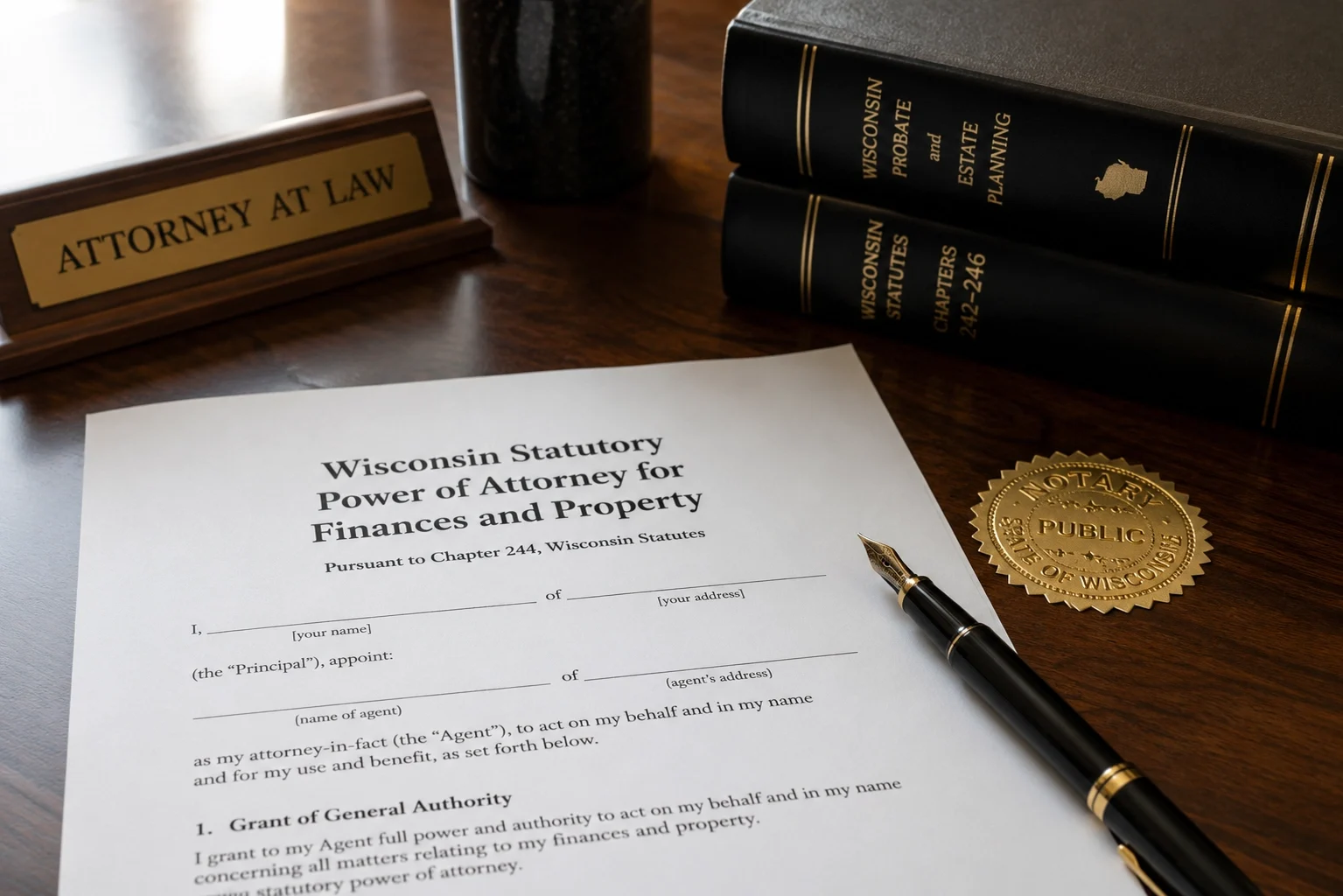
Wisconsin Power of Attorney — The Basics
Wisconsin’s Power of Attorney framework is set out in Wis. Stat. Ch. 244, Wisconsin’s adoption of the Uniform Power of Attorney Act. Wisconsin adopted the UPOAA effective 2010, replacing the older Wisconsin POA framework. The current framework includes:
- A statutory short form for Wisconsin Power of Attorney for Finances and Property. This is a checkbox-style form that grants specified authorities to an agent. The form is recognized by Wisconsin title companies, banks, and other institutions.
- A separate Wisconsin Power of Attorney for Health Care for medical decisions. Distinct from the finance/property POA and not relevant to real estate sales.
- Durability is the default. Modern Wisconsin POAs are durable, meaning they remain effective even if the principal becomes incapacitated. Older non-durable POAs may not survive incapacity.
- Signed in front of a notary. The Wisconsin statutory POA requires notarization. Witnesses are not statutorily required for the property/finance POA (unlike Wisconsin healthcare POA which requires two witnesses).
What Sellers Say About Cash House Buyer WI

“I hadn’t seen the house in 3 years. They still bought it.”
The property was falling apart and full of junk. Cash House Buyer WI gave me a fair offer and handled everything. I didn’t have to step inside once.

Jason Beezely
“The city was threatening to fine me. Cash House Buyer WI stepped in fast.”
I thought I was out of options. They gave me a cash offer in one day and closed before things got worse.

Pamela Newsom
Real Estate Authority — Why It Must Be Explicit
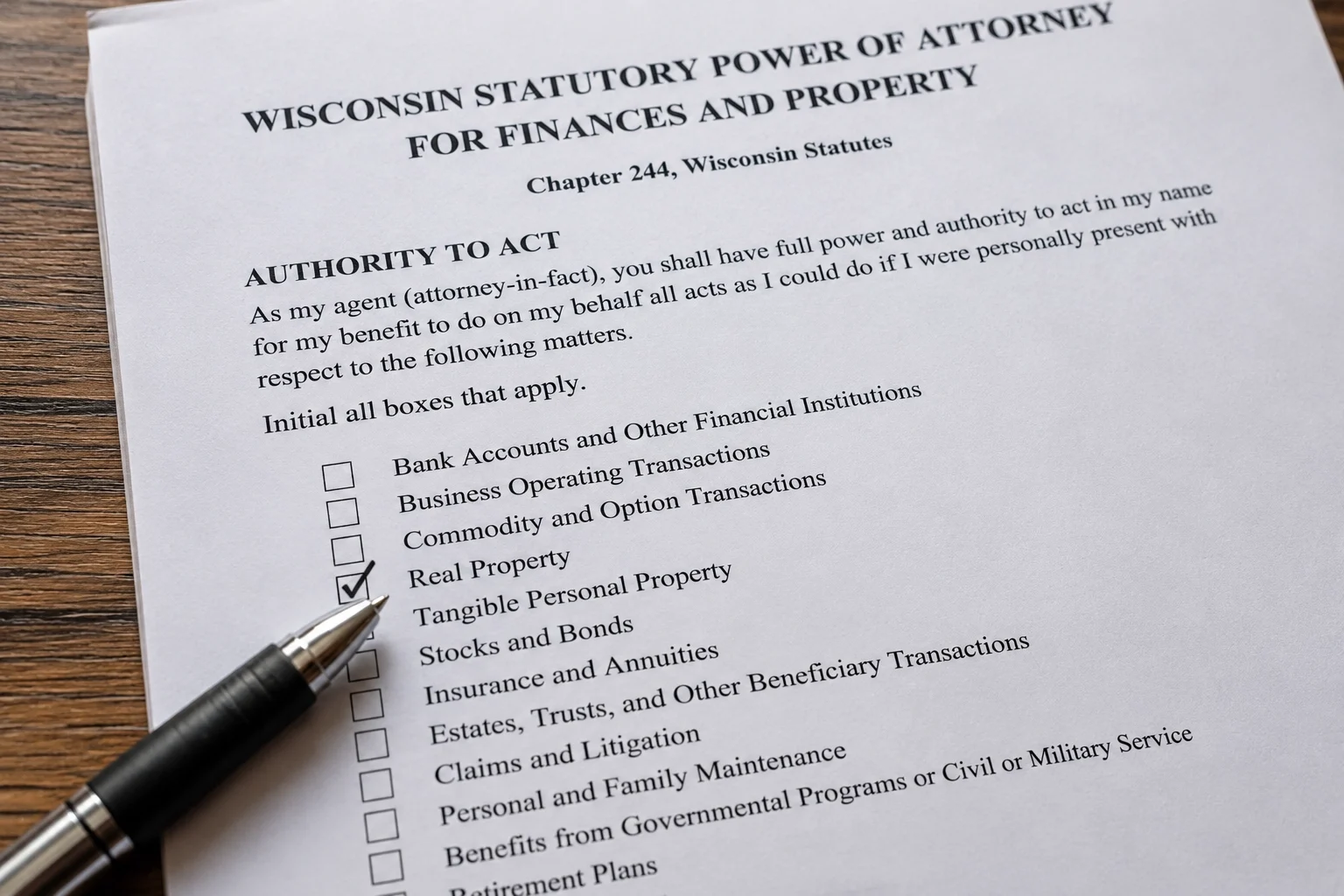
Here’s the single most important fact about Wisconsin POA for real estate purposes: authority to sell or transfer real estate must be EXPLICITLY GRANTED on the Wisconsin statutory short form. A general POA grant alone may not be enough.
The Wisconsin statutory short form lists specific authority categories that the principal can grant to the agent — including ‘Real Property’ as a specifically-checkable category. If that box isn’t checked (or if equivalent specific language isn’t included in a non-statutory POA), the agent may not have authority to sign a deed conveying the parent’s home, even though the general POA is otherwise valid.
In practice, this means three things for Wisconsin POA-driven home sales:
- Locate the original POA document. Title companies will request the original notarized POA at closing — not a copy. If the original is lost, the family may need to obtain a certified copy from the Wisconsin attorney who prepared it or, in some cases, execute a new POA if the principal is still competent.
- Verify the Real Property authority is granted. Read the POA carefully (or have an attorney review it) to confirm the agent has explicit authority to convey real estate. If the box is checked or specific real-property language is present, you’re set. If not, the POA may not work for the sale.
- If real-property authority is missing AND the principal is still competent, execute a new POA. A Wisconsin estate-planning attorney can prepare and execute an updated Wisconsin statutory POA in a single meeting at modest cost (~$200-$500 typical). This is far simpler than the alternative.
What Happens If the Parent Is No Longer Competent
Wisconsin POA must be signed while the principal is competent to make the decision. If the parent is already cognitively impaired (advanced dementia, post-stroke, etc.) and cannot understand the POA document, the parent cannot validly execute a new POA. In that situation, the alternatives are:
- Use an existing POA if one was signed before the impairment. Most Wisconsin POAs are durable and remain effective during incapacity. If a real-property-authorized POA exists from years earlier, it’s still valid and the agent can proceed with the sale.
- Petition for guardianship under Wis. Stat. Ch. 54. If no usable POA exists, the family needs to petition the Wisconsin Circuit Court for guardianship of the parent. The process typically takes weeks to months, requires medical documentation of incapacity (a physician’s affidavit), and involves attorney fees and court costs. A Wisconsin elder law attorney handles these petitions routinely. Once the court appoints a guardian of the estate, the guardian has authority to sell real estate (subject to court approval requirements).
- If a spouse is alive and competent and the home is titled in both names (Wisconsin marital property — Wis. Stat. Ch. 766), the spouse can sometimes execute the sale alone or with limited authority. This depends on title structure, marital property agreements, and other facts. A Wisconsin real estate attorney should confirm before assuming this works.
Wisconsin Marital Property — Spousal Joinder Considerations
Wisconsin is one of only nine marital property states. Wis. Stat. Ch. 766 governs how property acquired during the marriage is owned. The practical implication for senior real estate sales: even when the home is titled in one spouse’s name only, the other spouse may have a marital property interest and may need to sign the deed at closing.
For POA-driven sales, this means two layers of attention may be needed:
- Does the acting POA have real-property authority for the title-holding spouse? (Wisconsin Ch. 244 issue covered above.)
- Does the marital property interest of the non-title-holding spouse also need to be addressed? Sometimes the spouse signs separately. Sometimes a marital property agreement clarifies the ownership. Sometimes a separate POA covering both spouses is the cleanest solution.
A Wisconsin title company will identify these issues during title work and advise on what’s needed at closing. The Wisconsin State Bar’s Lawyer Referral and Information Service can connect families with experienced Wisconsin real estate or elder law attorneys if independent review is needed.
How Cash House Buyer WI Handles POA-Driven Closings
Over 30 years of buying Wisconsin homes, I’ve handled many POA-driven senior closings. The process with my team:
- Step 1: You send me a copy of the POA document early in the conversation (before we get to closing). I’m not a lawyer, but I review the document to confirm Real Property authority is granted. If anything looks off, I’ll tell you to have a Wisconsin attorney review before we go further.
- Step 2: At our walk-through and offer stage, the POA agent (typically the adult child) is the primary point of contact. The senior parent may be present or may not be — that’s the family’s call.
- Step 3: The Wisconsin title company runs title and identifies any marital property or other procedural considerations. The title company will confirm what’s needed at closing.
- Step 4: At closing, the POA agent presents the original notarized POA document and signs the deed and closing documents in a representative capacity (typically as ‘John Smith, as Agent under Power of Attorney for Mary Smith’). The title company verifies the POA’s real-property authority and records the transaction properly.
- Step 5: Proceeds wire to the senior parent’s account (or to a structure your estate-planning attorney has set up if Medicaid planning is in process). Title transfers to me. The transaction is complete.
Frequently Asked Questions
Does Wisconsin POA automatically include real estate authority?
No. Under Wisconsin’s Uniform Power of Attorney Act (Wis. Stat. Ch. 244, effective 2010), authority to sell or transfer real estate must be explicitly granted on the statutory short form (typically by checking the ‘Real Property’ authority box). A general POA grant alone may not be enough. Title companies will request the original notarized POA at closing and verify the real-property authority is present.
What if a Wisconsin parent’s existing POA doesn’t include real estate authority?
If the parent is still competent, a Wisconsin estate-planning attorney can prepare and execute an updated Wisconsin statutory POA in a single meeting at modest cost (~$200-$500). If the parent is no longer competent, the family may need to petition the Wisconsin Circuit Court for guardianship under Wis. Stat. Ch. 54 — a longer process requiring medical documentation of incapacity.
Is Wisconsin a marital property state?
Yes. Wisconsin is one of nine marital property states. Real estate acquired during the marriage may be marital property under Wis. Stat. Ch. 766 regardless of how titled. The practical effect for senior real estate sales: even when the home is titled in one spouse’s name only, the other spouse may have a marital property interest and may need to sign the deed at closing.
Will Cash House Buyer WI close a sale signed under POA?
Yes. We routinely close Wisconsin senior transitions with POA-driven signings. The POA agent (typically the adult child) sends a copy of the POA early for review, the Wisconsin title company verifies real-property authority at closing, and the agent signs the deed in representative capacity. Mike Messmer coordinates the procedural moving parts directly.
Talk to Mike
If you’re an adult child holding a Wisconsin POA for an aging parent and you’re thinking about selling the family home, call me at (414) 246-0032 or email Mike@cashhousebuyerwi.com. I’ll walk through the POA review, the timeline, and what a cash sale would look like. No pressure. — Mike.